Showing posts with label painting. Show all posts

Wednesday, May 30, 2012

Pop Inspiration: Loki

Artists are always inspired by the manifestation of beauty, whether it be a tiny bubble of dew on the petal of a perfect flower or the honey-sweet note of a song. I never expected to find reverence and awakening in a film like the Avengers. Sure, there's a lot to experience in such a blockbuster, but Tom Hiddleston's portrayal of the movie's villain Loki is truly a thing to behold. In order to be believable and ultimately feared, a villain must have a blinding depth. Mr. Hiddleston plays this character as if every moment is an evaluation and Loki's soul is found wanting time and again. That drive for approval and self respect is what fuels his deadly fire.

A Pain That I'm Used To
Photoshop and Wacom tablet

Creative types fall prey to disappointment and defeat so easily. Though some may find it strange to be uplifted by the 'bad guy' in a comic book film, that's just what's happened. Watching this character come to life, shaped by the hands of the masterful Hiddleston, was just the tonic for me. Perhaps that's what being part of the creative community is about; using your talents to help others reach their potential. To quote the actor, “Never let anyone tell you what you can and can’t do. Prove the cynics wrong. Pity them for they have no imagination. The sky’s the limit. Your sky. Your limit.”

Glorious Burden
Original vector art

Friday, April 6, 2012

Idea Seeds: Dogwood

With spring comes a lot of inspiration. Everything's waking up after a winter's nap; there are colors and textures everywhere. One of my favorite things about spring is the dogwood tree. Dogwoods are pretty trees most of the year, but their blooms are something special. That's why I've chosen dogwood as this Idea Seed.

Viewed by some as a religious symbol and prized by landscapers for its foliage, the dogwood comes in both tree and shrub varieties. The blooms can range from a chartreuse shade of white to light and dark pink and have four petals with a distinct dark spot on the tip. These blooms are showy in spring and give way to simple leaves for summer. Eventually, they produce bright berries.

Sun Salutation
watercolor

©Rachael Sinclair


If you have a dogwood tree in your yard or know where you can inspect one, take a good look. Does the shape inspire you? How about the color? What textures do you see? Sit under a dogwood and let your mind drift. You never know what magic you'll find!

These PMS colors and CMYK breakdowns were sampled directly from the bloom of a dogwood tree


Tuesday, April 5, 2011

Painted Easter Eggs

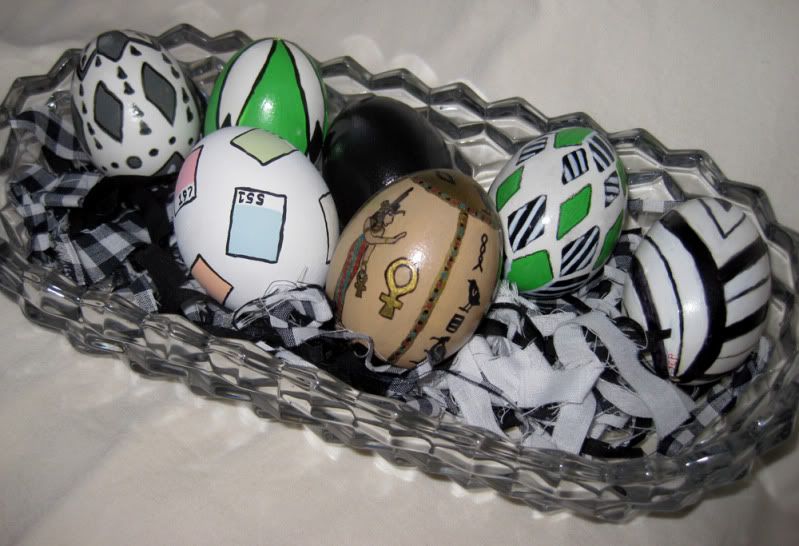
Around Easter time as a child, I remember watching my mother use a needle to drill a small hole in either end of an egg. She would then blow the contents into a dish, leaving a light and delicate shell. We would paint the shell in all sorts of styles and patterns; the possibilities were endless! I think projects like these were a primer for what I (with my mother's assistance) would do later on: painting life-sized fiberglass horses for a public art project. When almost anything can be your canvas, limits are few.

For centuries, egg decorating has been a staple in the springtime. Painting and decorating hollowed-out eggs is really fun and, I believe, develops one's patience. I will outline below the tools and procedure needed to create a cute decoration for your home or great gift for a friend.

The black, green, and white eggs along the back were done by my mother.
I painted the ancient Egypt egg in my late teens and I did the Pantone chip egg this year.


What You Need:
egg (any type will do, but I prefer plain white large eggs.)
needle (upholstery or leatherworking needles are great, easier to hold and stronger)
bowl
paper towels
acrylic paints
paint brushes
thread and/or small guage wire
spray sealer/fixative
egg cup, pill bottle, or small sturdy object to hold the egg while drying
Optional
hair dryer
glue on jewels
scrapbooking decorations (stickers, embellishments)
beads
beading thread or cord

What To Do:
You will be putting your mouth on the egg, so wash the egg first with soap and warm water. Dry it well and use the needle to slowly poke holes at either end of the egg. I usually do this gradually, making small holes side by side until I make one large enough to allow the insides to escape. Once you start blowing on the egg, you may have to make your hole larger if nothing comes out.

Keep a towel handy to wipe away dampness along the way. With the egg over a bowl to catch the insides, blow through the hole on one end. You may have to use your needle or some small wire to loosen the insides and help break up the yolk. This process isn't swift, so be patient. You will know when the egg is hollow.

Use your faucet with a small stream and try to get some water inside the egg. Hold your fingers over the holes and shake. This will help to rinse out as much of the egg liquid as possible. Blow the water out. You can repeat this process until the water comes out relatively clear. Set the egg, one of the holes down, on some paper towels (like a nest) to drain further. I usually let them drain for 24 hours. Remember to use the egg contents for something great like an omelet or perhaps some cupcakes or cookies!

Once the egg has drained, it's time to decorate! Base coats aren't necessary, but I usually do a coat of white or black acrylic depending on the design I intend to implement. You will find that you cannot paint all of the egg at once (that patience thing I mentioned). Do one half at a time, setting the egg in a cup or rest on the mouth of a pill bottle to dry. Acrylic craft paint usually dries quickly, so you shouldn't have to wait long. If you desire, you can use a hair dryer on cool to speed the process.

If you choose, you can decorate your egg with pre-made embellishments, like the ones used for scrapbooking. Small, flat-backed items like buttons and jewels are also an option. Stick them on a flat-color painted egg for a striking effect. But keep in mind, eggs aren't flat like scrapbook pages. The smaller the items the better since larger items may not lay flat against the round surface.

Once you're satisfied with your egg, you can string some small wire through to give you something to hold to and spray coat the design with fixative. Matte finish is usually best and the easiest to work with. If you've used scrapbook or other elements as a design, this step isn't recommended. You may choose to spray coat the egg before attaching embellishments however. The spray coat helps reinforce the egg a bit, but remember, this is an egg and it is not indestructible. You may break a few, but if you're careful, you won't lose many.

There are many ways to display your eggs. You can string them like ornaments, set them one by one on a mantel, table, or windowsill, or put a group of them in a basket. You may find that once you've made one, you have the compulsion to make more. They make great hand-made gifts and can be reused from year to year if sealed properly and packed carefully. This is a fun craft that really gets the imagination churning. Pick up an egg and... see what hatches!


Tuesday, February 15, 2011

Color Flavor: Lavender

"Lavender is for lovers true, Which evermore be faine; Desiring always for to have Some pleasure for their paine: And when that they obtained have The love that they require, Then have they all their perfect joie, And quenched is the fire."-Clement Robinson 1584 (Handefull of Pleasant Delites)
A member of the mint family, lavender doesn't disappoint when it comes to fragrance. This flower's essence is used in everything from perfumes to candles, medicines to foods. From it's earliest history as a component in oils in ancient Egypt and a ward against the Plague, to it's many applications today, lavender is more than a nice-smelling flower. Lavender is a color often overlooked in design because of its tendency toward the feminine. But this beautiful spectrum of pinks, blues, and dusky purples is rife with possibility.

Purple, the color most would associate with lavender, has a royal, rich connotation. Used in darker forms, purple of both blue and red tints can be stuffy and overwhelming. Lavender is a toned tint that combines the sophistication of purple with the livability and freshness of a near pastel. It can be utilized to give a tinge of 'royalty' without being overwhelming.

Used many times to hint at romance, lavender is perfect for romantic products or marketing. It goes without saying that lavender is great when used for products or web sites that target women. It's also excellent as a main or accent hue for organic businesses because the plant itself is used frequently in natural and organic products. See the logo pictured for the fictitious 'Secret Garden' organic tea cookies. When paired with shades of gray, brown, or even orange, lavender can add just the right gentle freshness to a modern, masculine design.

The first room here is treated in the usual romantic way. Butter-cream walls and a toasted marigold ceiling (Behr: Quiet Veranda 350F-4 and Honeysuckle Blast S-H-330) are accented with a medium-tone lavender. This is certainly a feminine dining area, but is also quite provincial. This scheme would work well in a colonial or Victorian home.


The second room, a kitchen, uses a putty gray and vibrant lily orange (Behr: Country Club 770B-5 and Orange Spice 250B-5) to wake the senses and keep the lavender from being too soft. A storm cloud blue (Myth 740F-5, also Behr) is used to chill the warm orange and wood counter tops. This room could be too modern and cold, but the addition of lavender can help almost anyone feel comfortable.


I love lavender, both the color and the plant. It has always been a favorite of the women in my family. I remember sitting with my mother and grandmother making lavender sprig sachets woven with ribbon. As a special treat, I would like to share with you a cookie recipe that I make from time to time. This refrigerator shortbread is great with tea or just as a refreshing sweet treat.

Lavender-lime Shortbread

1 cup (two sticks) unsalted butter, at room temperature
1 cup sugar (¾ cup powdered sugar, ¼ cup coarse raw sugar)
1 teaspoon vanilla extract
½ teaspoon salt
2 cups all-purpose flour (plus more for rolling)
1 tablespoon dried lavender flowers (you can use a bit more if you wish)
zest of one lime

To begin, comb the dried flowers for pieces of stems and leaves. Then crush the flowers using a mortar and pestle along with the ¼ cup of coarse raw sugar. Using this coarse sugar will ensure fine grinding of flowers. Combine in an air-tight container with ¾ cup powdered sugar and let sit overnight or as long as desired. The longer the sugar and flowers infuse, the more intense the aroma and flavor.

To make the cookies, first combine the sugar, butter, vanilla, salt, and lime zest. Beat with an electric mixer until smooth. Add flour slowly and mix just until the dough begins to form. Divide the dough into two equal halves. On wax or parchment paper, roll each half into a 1 ½ inch diameter log. You may want to flour your hands if the dough is sticky. Refrigerate the dough until firm, about 1-2 hours. If you refrigerate longer than 1-2 hours or wish to store the dough and you've used wax paper, make sure to wrap also in plastic wrap.

Preheat the oven to 350 degrees. With a serrated knife, make slices approximately 3/8 of an inch thick and place about an inch apart on a baking sheet. If your dough wants to crumble when slicing, let sit at room temperature for a few minutes. Bake for 15 to 20 minutes or until golden around the edges. Cool on the baking sheet for a few minutes then transfer to rack to cool fully.


Aromatic
original watercolor
© Rachael Sinclair 2011

Monday, November 8, 2010

Jennie Augusta Brownscombe

Among the artistic depictions of the first Thanksgiving shines one by 'Colonial Revival' artist Jennie Augusta Brownscombe. This particular oil on canvas (titled aptly, 'The First Thanksgiving') was painted in 1914 and published in Life magazine where it reached a wide audience. The sweeping composition and attention to detail make her view of Thanksgiving's advent particularly engaging.

Given the distinction by some as being 'the Norman Rockwell of her time', Brownscombe was born in Pennsylvania in 1850. Her mother, Elvira Kennedy, was a descendant of an original Mayflower passenger. She was an artist from an early age and by 1868 was supporting herself with her craft by selling illustrations to magazines and licensing her paintings for reproduction. She studied in New York and France, lived in Rome and had exhibits of her work there and in London.

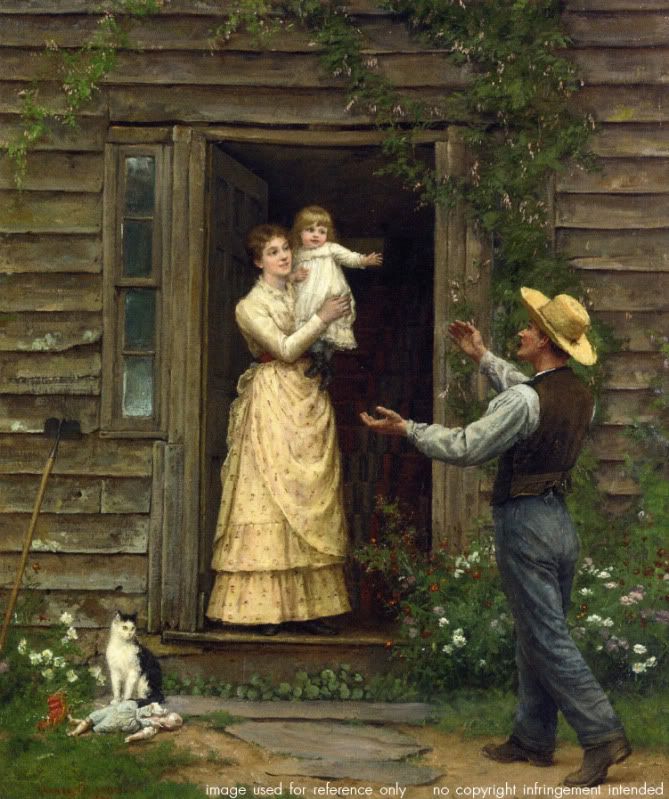
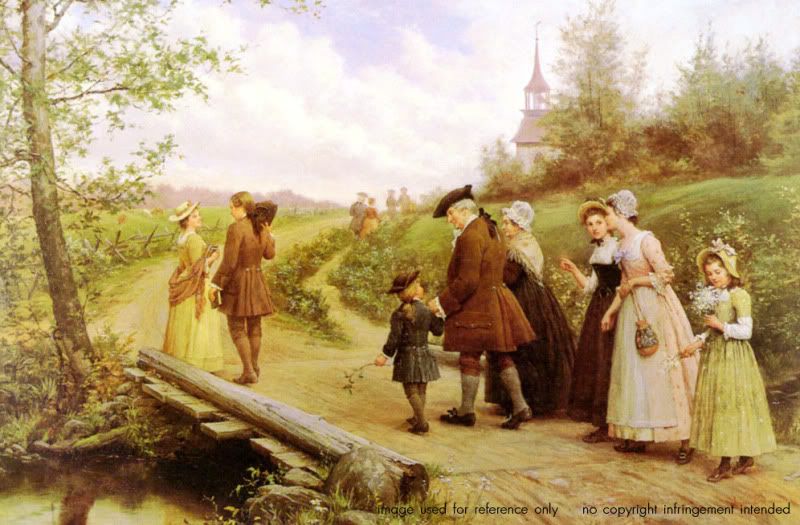
Studies of every day life have long been a passion for artists. There's a sense of oneness with the art when you can relate to its subject. In one piece, we see the happy faces of a family reunited while a cat looks on, the rustic shingles on the house testifying to Brownscombe's skill. In another, we join a procession of colonials on their way to church on Sunday morning. It is peppered with such minute details as a branch in the young boy's hand and cattle grazing in the background. Brownscombe painted what she knew, emotions she could connect with. Her use of color was joyful and engaging, her subjects like family.

Jennie Brownscombe was a pilgrim in her own way, making a name and life for herself in a time when most women were still housewives and mothers. She tapped into a talent and nostalgia that warmed the hearts of her viewers. Artists like Brownscombe place a mirror to our lives, forcing us to see the beauty in every day. Creative types can sometimes become bogged down with visions of the fantastic. A reminder of the subtle grace of life is always welcome.


Tuesday, August 31, 2010

Charles Rennie Mackintosh


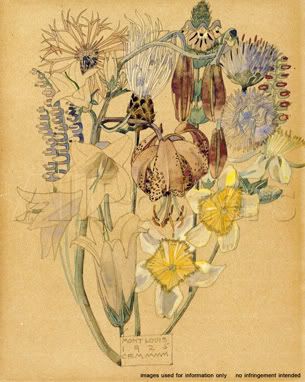
Art nouveau, arts and crafts, and art deco are some of the most popular types of art and architecture. There's something breathtaking and decadent about the lines and materials. In the midst of artists like Tamara de Lempicka and Erté and the achievements of architects the world over, we find Charles Rennie Mackintosh. Born in Glasgow, Scotland, Mackintosh was talented in many creative fields, but is perhaps most well known for his architecture.

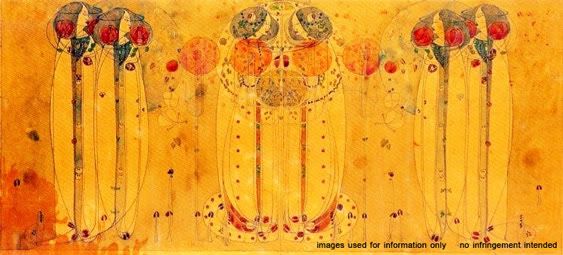
Throughout his life, Mackintosh displayed a singular style, one that ran closely with those of his contemporaries, but still had its own flair. One of his signature elements was a highly stylized rose. You can find it on a number of his pieces, whether architecturally or in paintings. He utilized vertical lines in long succession, peaceful symmetry, and tone saturation in paint and materials. The lines, textures, and figures were a pleasing hybrid of nouveau and deco. His less architectural work still maintained a bone of structure that was very Mackintosh. Human figures and flower stems were long and lean, curving like ceiling trusses.


What's popular is often imitated, most of the time by 'small fish in big pond' artists and architects, people whose names escape the scholar's tongue. The art styles of the day can bring accolades, but a true craftsman must always put a individual stamp on his or her work. Mackintosh was a quintessential creative of his era, but his work is one that people can instantly recognize. For that reason, he set himself apart and made himself a singular cultivator of inspiration.

Friday, August 13, 2010

Charles Sheeler


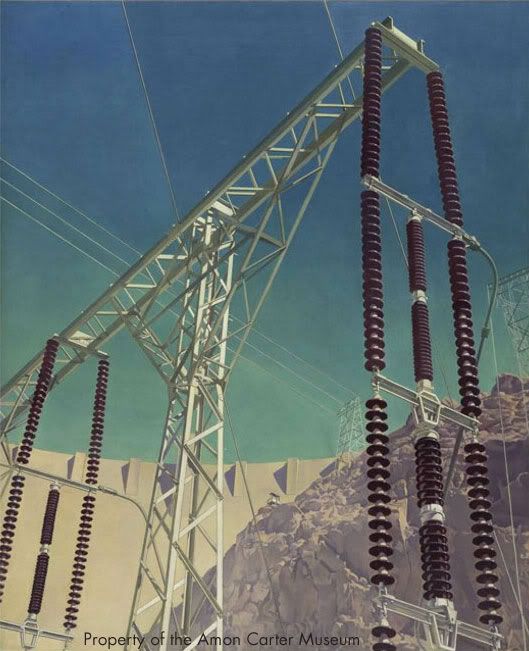
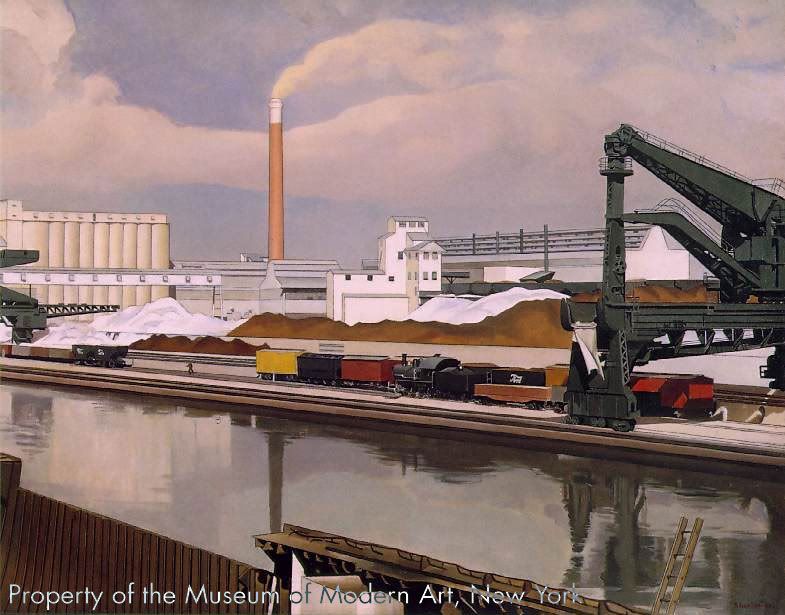
Precision can be a scary term. It can put one in mind of mechanical things whirring away, sterile workplaces, frightening scores of algorithms. But precision can be beautiful. Engineering, mechanical things, these things are as much creativity and art as any painting or sculpture. Precisionism was a term coined by Charles Sheeler, an artist and photographer at the forefront of modernism in its early stages in the United States.

Born in 1883, Sheeler's painting went hand-in-hand with his photography and vise-versa. He eschewed organic forms, keeping humans and other living things far from his work. But to say his work lacked character and brilliance would be a falsehood.


In 1927, Sheeler spent weeks photographing and basking in the glory of one of Henry Ford's 'modern' car plants. He was terribly impressed with it, going as far as to trumpet this revolution in machinery as 'religious expression'. His painting "American Landscape" is possibly the epitome of his precisionism. This breathtaking composition of steel, iron, smoke, and sky spoke volumes to what inspired Sheeler.

Creative people, especially fine artists and photographers, tend to learn by example of what is beautiful. Flowers, landscapes, rubenesque women; these things are widely accepted as pleasing. Sheeler's eye to the man-made can lead us down a different path. Industry isn't ugly, not if you view it with the right perspective. Precision is tackling every aspect of something with text-book perfection. Sheeler studied line, form, and color so closely that even the cold and mundane became a masterpiece.

Sources: The Artchive, Wikipedia, Art Knowledge News

Monday, August 9, 2010

Narciso Abeyta

Native American art, to me, is in a realm by itself. Distinctive and storied, native work paints a breathtaking portrait of these proud and spiritual people. An episode of Antiques Roadshow from years past introduced me to the art of Narciso Abeyta or Ha So De. Abeyta's style was a perfect mix of traditional and contemporary.

Born in 1918, Abeyta, was a Navajo 'Code Talker' in WWII before returning home to attend the University of New Mexico. He was recognized for his energetic and flowing style, one that simplified forms into streamlined swashes of color and pattern. The lines hearken back to cave paintings, something Abeyta did as a child.

When creating, we should always be open to all sorts of influence. 'Art history' can mean a number of things. The paintings of Narciso Abeyta are at once historical, contemporary, and classic, a combination that moves the spirit and the creative juices.


Sources:
NativeWiki , Antiques Roadshow

Note: Cultivators of Inspiration is a feature I will continue to post from time to time. If there is someone out there who inspires you, post a reply and point me in their direction. Share and share alike!