Showing posts with label shopping. Show all posts

Wednesday, September 8, 2010

Fashion Frankenstein: New Life for Old Clothes

In an earlier post, I discussed how unexpected things can be repurposed as storage. But that's not as far as repurposing goes. What happens when you get a stain on your favorite shirt or there's a rip in those jeans you now can't bear to wear in public? What about thrift shopping? Can a $2.50 sweatshirt really get a new life? I say yes!

Sometimes I grab something like a spent pair of my husband's jeans or a team sweatshirt from Goodwill and stare at it. I literally eye-ball the thing with a vengeance, trying to see what's 'inside' it. Just because something started as pants or a shirt, doesn't mean it can't be something else. After all, these things are simply pattern pieces cut from fabric just like anything else. 
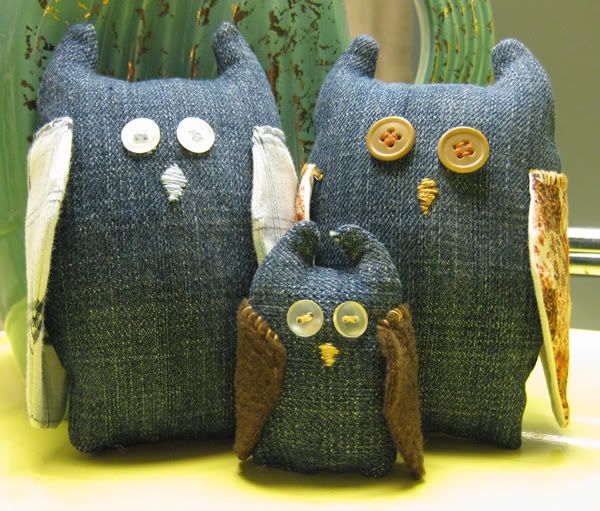
Jeans, paired with sewing scraps, perhaps those from an old button-down shirt, can become a stuffed animal like these owls.

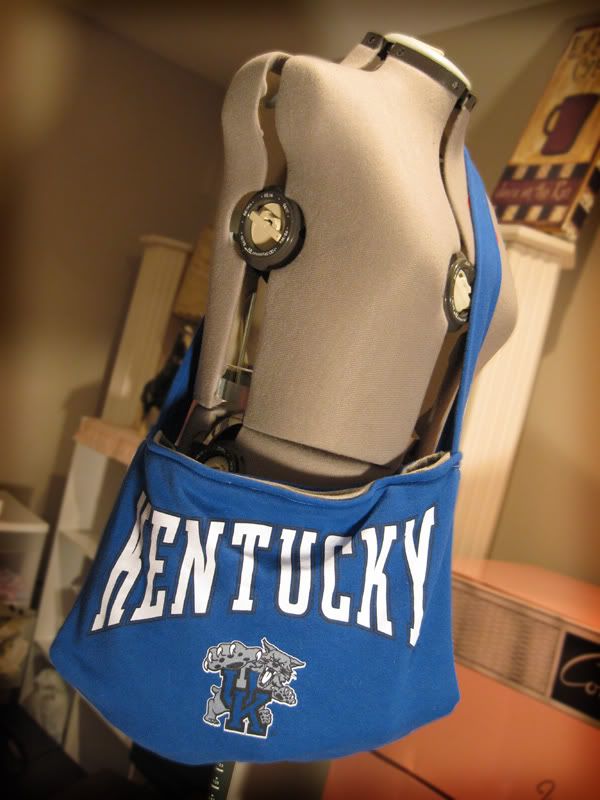
A sweatshirt, paired with another one for lining, can be deconstructed and given a new life as a shoulder bag. This purse had a material cost of under $10. I even used the left-over scraps and stretchy band from the bottom to make some fingerless mittens. They're toasty!
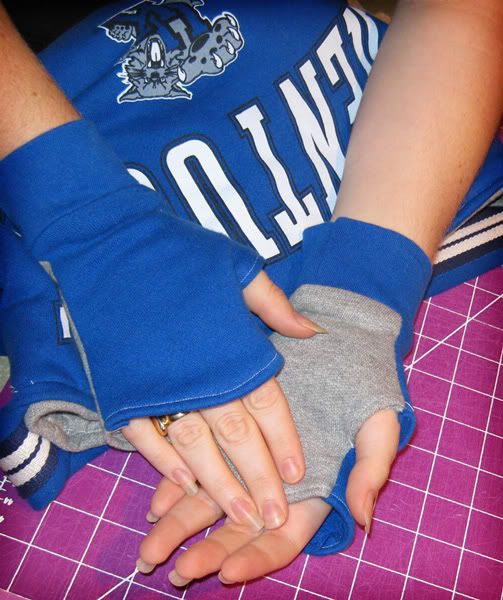
So what do you have lying around? Do you have some fabric that is currently living life as an old skirt with a bleach spot or a pullover with a tear. Is it secretly dreaming of being something more? Have some one-on-one time with your old clothes, ask them what they want to be, and make it happen! If you doubt your creativity at first, there are a number of sites and blogs with patterns and instructions. Do a search and go from there. But the next time you think of tossing out those clothes, don't; let them be reborn!

Sunday, August 29, 2010

Imagine the Possibilities: Unexpected Organization

It seems we're always searching for ways to organize our lives. Sometimes, those of us with a stubborn creative streak (and a stubborn thrifty streak) try to organize in fun, cost-efficient ways. In an environmentally conscious world, we could all use to reuse. So why not look for unexpected ways to store and organize?


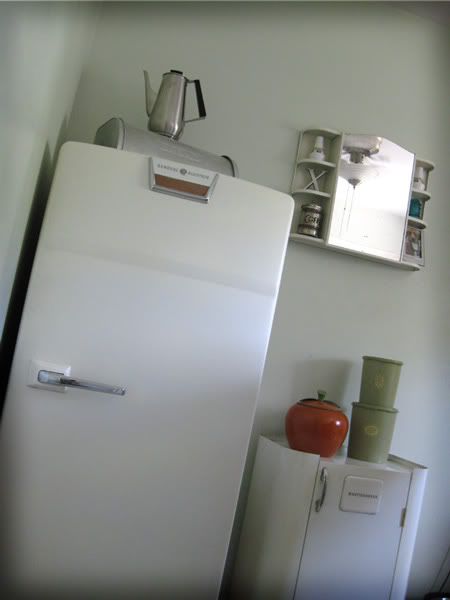
Over the years, I've kept a keen eye out for new ways to recycle, collect, surprise, and store. It all started with an old GE refrigerator we bought for $5 at a Habitat ReStore. We needed more cabinet space in our tiny kitchen without the thousands of dollars spent for a remodel. We gutted the fridge, cleaning out the old cooling motor and coils, insulation and rust, then repainted the outside. The 'fridge' holds cereal, snacks, chips, and canned goods. The door shelves are perfect for medications and vitamins. The small white Westinghouse cabinet followed as a way to store dog treats and food. On the wall hangs a medicine cabinet. This holds my spices and the mirror makes the small room seem a little bigger.

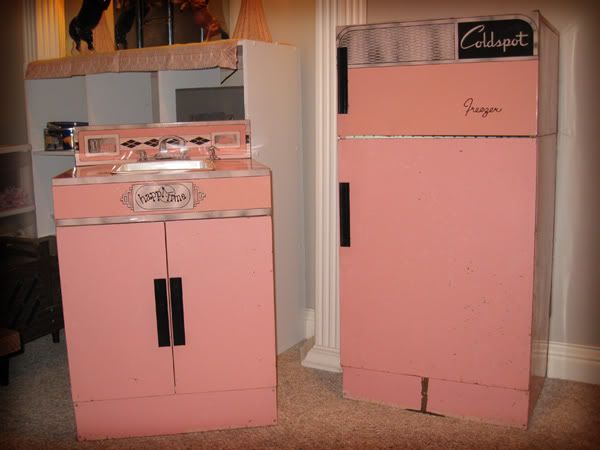
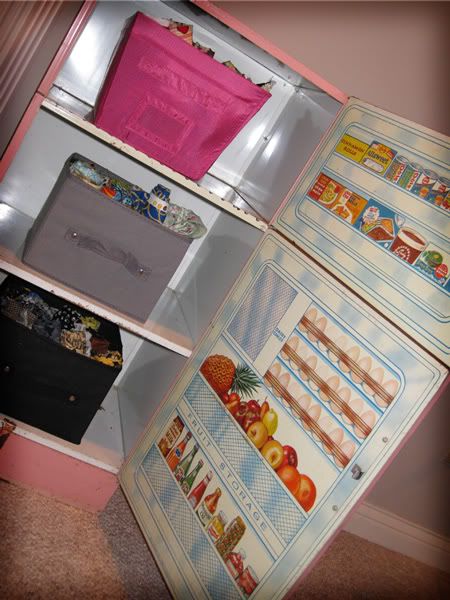
As a crafter, I'm always trying to find better ways to store my supplies. This folding magazine rack doubles as a filing cabinet. The two Sears Happi-Time toy kitchen pieces are essentially metal cabinets painted to look like a fridge and sink. I picked these up in an antique store's rough room at a steal. Canvas storage bins keep my fabric safe from the minimal rust. They may not look like storage, but they fit the bill while being ridiculously cute and vintage.

Storage and décor doesn't always have to march to the same old drummer. Finding new and creative ways to reuse furniture and various other things is almost as fun as painting, designing, sewing, or blogging. When you see something at a thrift shop, vintage or antique store, estate or yard sale, look at it with an eye to the potential. With a little imagination, elbow grease, and soapy water, something old can be new again in more ways than one!

Friday, August 20, 2010

Vintage Tins with Lots of Heart

Do you have Prince Albert in a can? I'm sure we've all heard that at least once before, but do we all know what it's about? The joke refers to Prince Albert tobacco sold in a tin can. Tins used to be the container of choice for all sorts of things from tobacco to candy. Now these tins are collectibles, great for interior design, and hold more than Prince Albert; they hold inspiration!


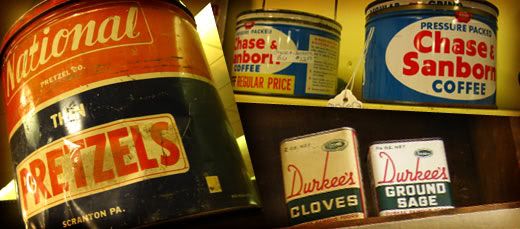
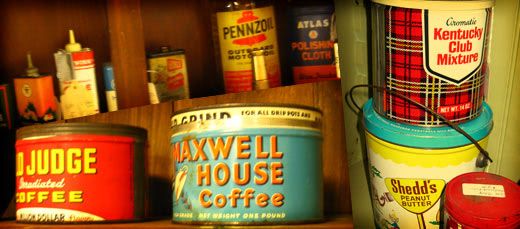
In 1810, Englishman Peter Durand patented the 'tin can'. Ever since, goods of all kinds have been sold in cans. Most cans today are vacuum packed with lids you have to open with a can opener or pull-tab. The tins I speak of in this post were mostly sold with easily removable lids and contained dry goods like coffee and pretzels, fats like lard, or tobacco. Though they were necessity in their time, the ones that survived have become quite collectible.

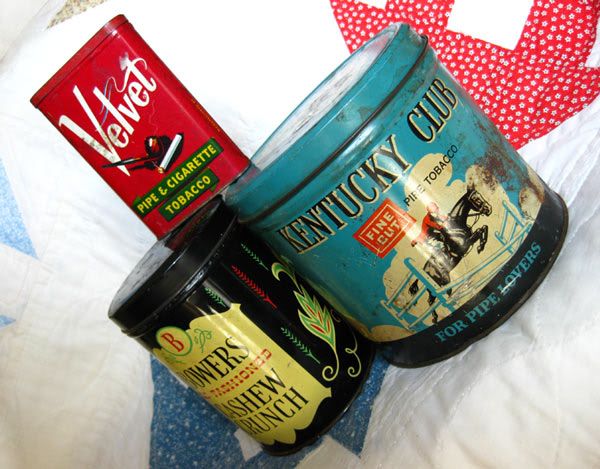
Though I don't boast a large collection of these tins, the ones I do possess have lots of design potential. My two tobacco tins are likely from the mid-20th century. They both sport bold branding and colors. I suspect they were most eye-catching when shiny and new. I spotted the Kentucky Club tin in an antique shop because of the fabulous green-tinted blue that covers most of the surface. The branding is classic with a strong serif font. Most of the graphics are crisp and flat; a dot pattern is clear on the horse and rider where it was screened to create shading. The horse, frozen mid-leap, is energetic, the white rail fencing bringing to mind rolling fields and high-class lifestyles. The secondary font is a simple san-serif.


The tin for Velvet tobacco has a more contemporary style for its time. The Velvet 'logo' is done in an upward-climbing calligraphic font, something popular in advertising from the early- and mid-20th century. The crossbar on the 't' ends in a whirl of smoke and is most playful. Other typefaces, like the secondary fonts on the Kentucky Club tin, are akin to Futura. The red makes this tin most visible on a knickknack shelf. Small things in bright colors are great for accents when you don't want to commit to large bright-colored pieces.

Bower's Cashew Crunch is the odd non-tobacco part of my small collection. This tin is tall and cylindrical with a glossy finish. Since the candy was 'Old Fashioned', the graphics needed to appear that way. This tin was most likely made near the same time as the others however. The fonts are serifs in an engraved style, tall and thin. The font used for 'Old Fashioned' is a 'western' serif, similar to the one used on 'wanted' posters. It can also bring to mind colonial needlework samplers. The accent graphics in red and green are superb, similar to those found in decorative pieces from 19th century New England and the Pennsylvania Dutch.


Vintage tins are fantastic decorative pieces. They can add just the right hint of roughness to a modern room. Foodstuff tins are excellent for kitchens. You can find things as large as foot-tall pretzel tins and as small as spice containers. Other tins, like those for tobacco and motor oil are at home anywhere, just be mindful of sticky stains, as some may have had leaks. When shopping for tins, try to look for authenticity as there are many impostors. Genuine tins will have appropriate aging and printing techniques for the time of manufacture. Don't be afraid of a little rust. Tins like these can run anywhere from $1 to $100, depending on age, condition, and rarity. As I've mentioned above, they're a wonderful trove of graphic, color, and typeface inspiration. You never know when you'll need just the right vintage look for a client, art piece, or product. And who knows, the next time someone asks if you have Prince Albert in a can, you may be able to proudly answer yes!


Tuesday, August 10, 2010

Java Junkie: Logos and Brews

Anyone who knows me, knows I love coffee almost as much as I love art and design. I started drinking coffee in college and have since become quite the connoisseur. Everywhere I go, I like to sample the brew from locally-owned shops. Though there are some who would argue Starbucks is the only place to get your coffee fix, I disagree. Here I will sample a few coffee shops I've visited. I've been to quite a few, but these sport the best coffee and perhaps nearly as important from a design perspective, the best logos.

First up is Java Brewing Company in Louisville, Kentucky. This logo is energetic and clean, but also has a nice bit of whimsy. The color choices are earthy without being too bland. The coffee here is rich and tasty, though some roasts have a slight bitterness.


Semolino is a small shop in the college town of Hays, Kansas. Housed in a revamped downtown building, the cafe's name alludes to the area's wheat farming industry. The logo is somewhat 'antique' and uses an aged red and burnished gold. You can almost see this logo on the side of an antique coffee tin. The java at Semolino is great, the atmosphere relaxing, and the baked goods tantalizing.

I have two offerings from the Gateway city of St. Louis. First, we'll take a look at Kaldi's. This shop takes its name from the legendary goatherd Kaldi. The story states that Kaldi's goats nibbled on coffee cherries one day and became filled with energy, leading him to 'discover' the fruit. The logo is a throwback to that story, exuding an African/Middle Eastern flair with the swirling roundel and dancing goats. Kaldi's is a must-see for anyone visiting St. Louis.

Northwest Coffee Roasters is a small operation with only two shops, but the coffee is superb. Sporting an elegant logo, Northwest sells coffee beans in slick black bags that set off the beauty of the logo. They roast all their own coffee, much like most of the others I've listed. I purchased a pound of their Italian Roast once and enjoyed it thoroughly.

The logo and corresponding graphics for The Roasterie in Kansas City, Missouri are simply the bees knees! The logo, with the tagline 'Air Roasted Coffee' has a distinctive early 20th century flair. The font choice and bold black and white graphics lend a retro industrial feel. Though the shop was terribly busy when I visited and it took a while to place my order, the coffee was fresh and crisp.

Lastly, I give you the Frothy Monkey. The name alone is enough to peak interest. I visited the one in Nashville, Tennessee. A very earth-friendly shop, the Frothy Monkey has an eclectic atmosphere and really tasty coffee. The logo is simply delightful with its friendly lower-case font and ambling monkey.

Local coffee shops are sometimes the best places to get a feel for the city. They're also great for the economy. Chain stores are fine, but venture off the beaten path and give local a try. You may find a new place to hang out and enjoy some joe. We creative types need fuel after all!

Note: All of these shops were in business at the time of this entry.

Thursday, August 5, 2010

Treasure Awaits

Yard sales, estate sales, and flea markets are like modern-day treasure hunts. No matter what you fancy or collect, you can find almost anything, many times for a bargain. These photos were taken on a recent trip to only a small portion of the “World's Longest Yard Sale” along highway 127. Though individual houses or neighborhoods may hold sales, the most interesting stops are the flea-market-type lots along the route. Here, vendors pay a small fee to set up shop throughout the yard sale's four days.

These types of sales are much like the hybrid of thrift and antique stores with some newer merchandise thrown in. Some vendors offer nicely set tables of wares, others are more like big purses; dig and dump. But don't be squeamish about digging. There is gold in them thar hills as they say. You never know what you may find in an old box full of junk. Getting there is half the fun, so explore. The more experience you have, the more you come to recognize potential 'good stuff'.

Bargaining is encouraged, especially if you know the market value of the item you want. If a price is too high, ask if they will negotiate. Sometimes they'll ask what price you had in mind, other times they'll offer something slightly lower than sticker. When quoting a price to a seller, try not to be too drastic. State an amount a tiny bit lower than you're willing to pay and see what happens. Asking never hurts.

When it comes to estate sales, the price is oftentimes non-negotiable, but again, it's not horrible to ask. Estate sales that stretch more than one day may discount prices on the last day of sale, so inquire about discounts if they aren't posted. Keep in mind, however, with all of these sales, something may be snatched up in seconds. If you really want an item and are willing to pay the price, grab it!

Whether you have a particular thing in mind or are just out for the hunt, yard sales, estate sales, and flea
markets are loads of fun. Yard sales and estate sales can be found in local papers or online and a quick internet search will locate flea markets in your area. These are great places for collectors or to score unique, vintage furnishings. They're also excellent troves of creative inspiration. Bring a camera or snap photos with your phone of things that inspire. Yesteryear's china pattern may someday become the springboard for an illustration or a color scheme for a web site. We all know that inspiration has a way of finding us, so take a trip to one of these sales and see if you can find it first!