Wednesday, February 27, 2013

Idea Seeds: Tractors

You can find them on the roads of rural America, often a line of traffic trailing. They're chugging along in the fields, left to rust next to old barns, and shined up for shows. They pull our parade floats and help plant, tend, and harvest not only our food, but our imagination. Tractors, especially 'vintage' tractors, are a wealth of nostalgia and design and that's why they're the feature of this Idea Seeds.

Some shallow research uncovers a vast world of color, design, and function. Tractors began as steam engines working in pairs. Now, a large piece of technologically advanced farm machinery can cost more than a house. These mainstays of the 'modern' farm are an indispensable part of crop production.
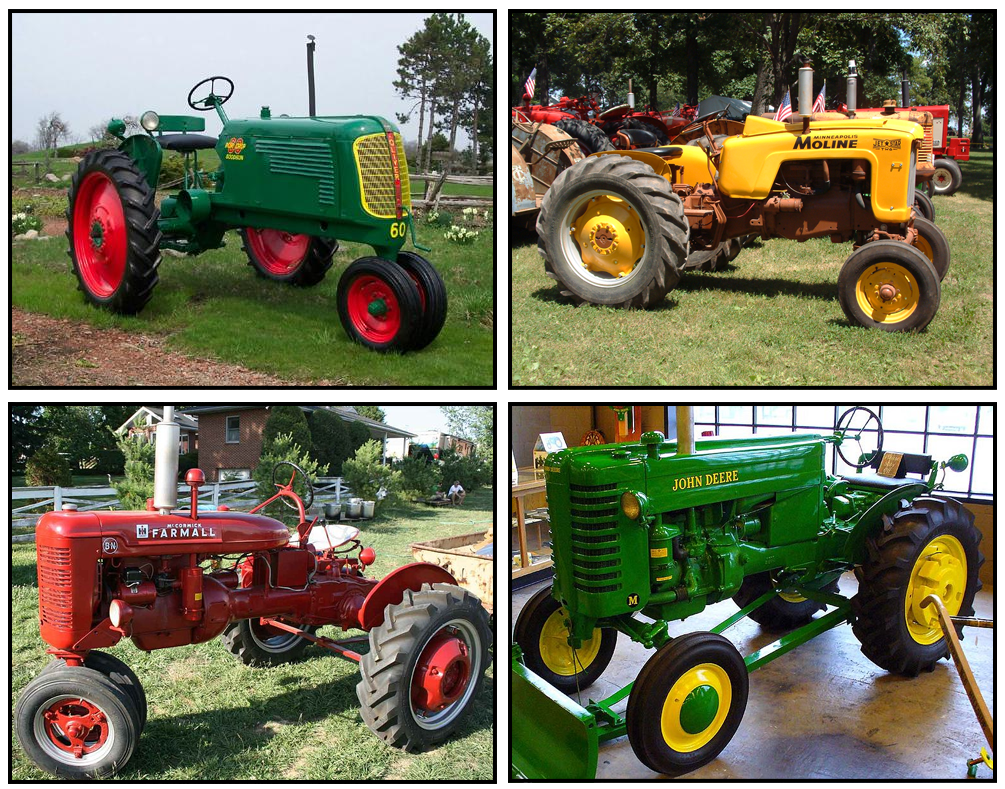

Images sourced from Wikipedia
Since these implements took over where horses left off, there have been a large number of manufacturers. There aren't quite as many today as in years past, but that's what makes vintage tractors so much fun. The colors are varied and vibrant, the forms utilitarian, but geometric and beautiful. 

What do you think when you see an old tractor? Do you envision a farmer, perched familiarly atop the metal beast, the sun in his eyes, with a field of corn in his wake? Perhaps you see an easy-going farm dog napping in the shade of an old row-crop. Maybe you focus on the design of the machine, its lines and graphic quality. And it just could be that you see generations of history in every layer of peeling paint.

I invite you to look into the world of farm machinery. Start with the old stuff (as it is oftentimes more visually pleasing) and settle in for quite a ride. You may not go over 20 miles an hour, but the inspiration you cultivate can certainly take you places.
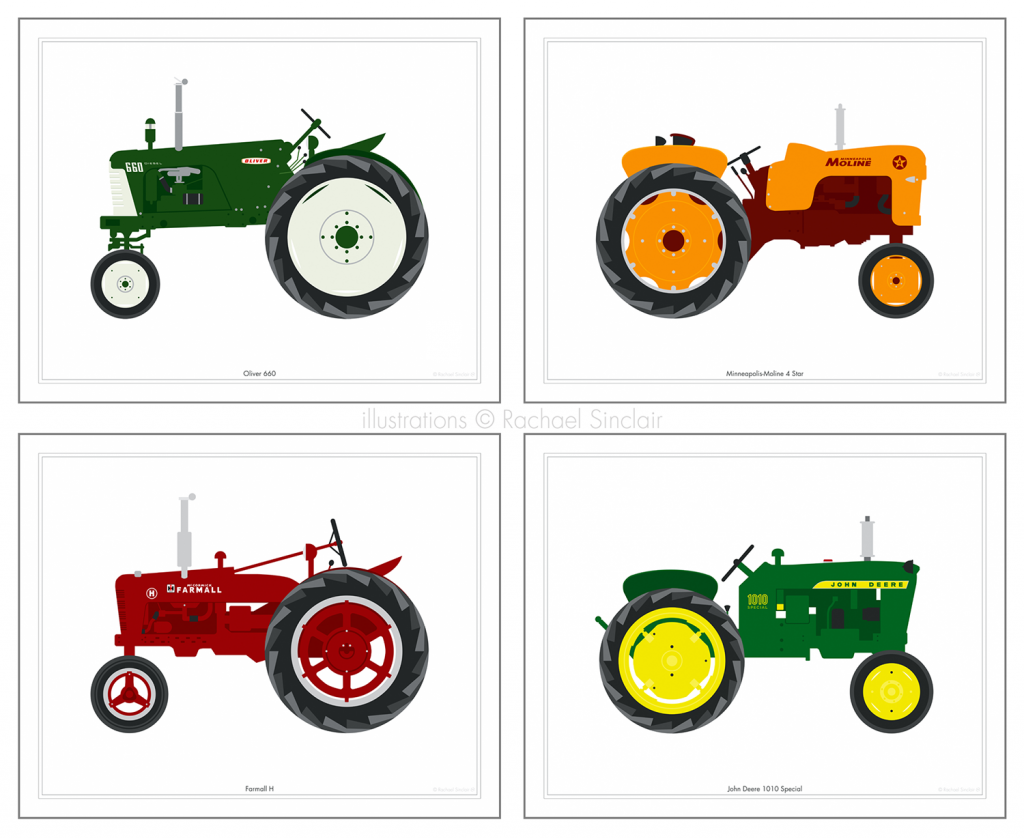

Vintage Tractors
Original vector illustrations © Rachael Sinclair
Available for purchase HERE

Wednesday, February 13, 2013

Happy Valentine's Day

I've never loved Valentine's Day, but I can't say I completely detest it. Who can resist chocolate, right?


Tuesday, January 29, 2013

Pop Inspiration: Fringe

Science fiction isn't for everyone, but one thing's for sure, it's a wild ride. A few weeks ago, television viewers waved goodbye to the dimension/timeline-jumping fun that was Fringe. Not only did the writing tease the boundaries of science, but it challenged our feelings and how we connect with the people and world we love.

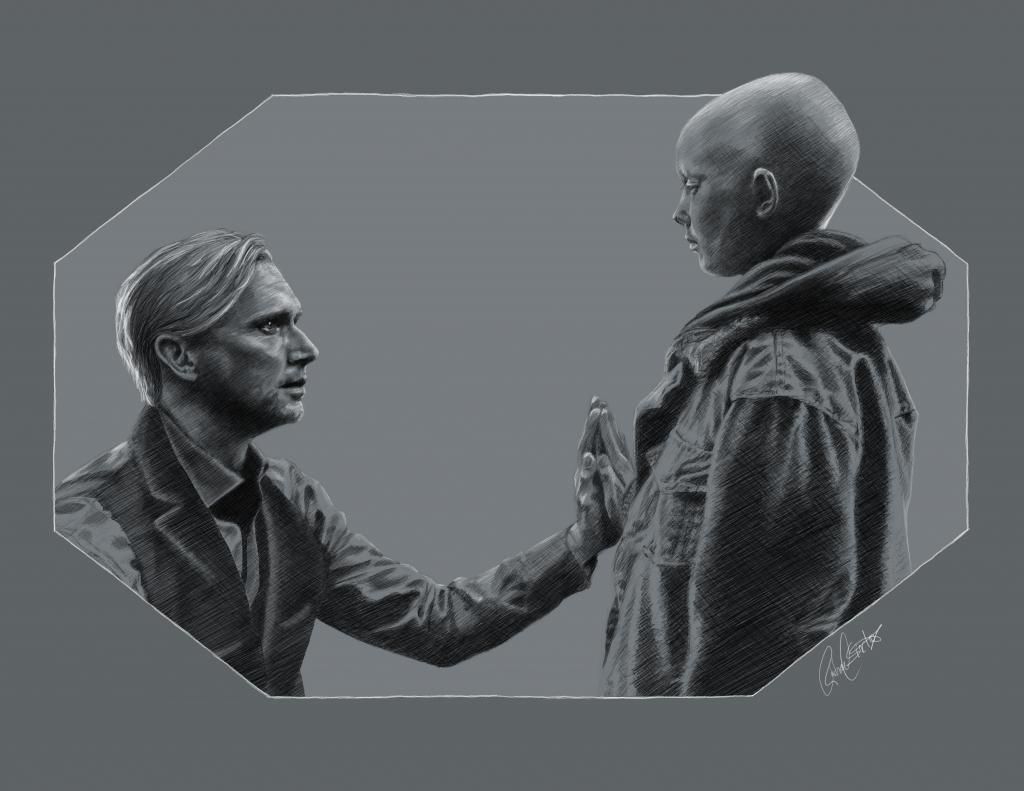
Among the relationships in Fringe I found particularly poignant was the relatively short-lived father/son bond between the former Observer September (now Donald) and Michael. The episode 'The Boy Must Live' gave us this amazingly deep, yet outwardly simple show of affection and communication between the two.

The Boy Must Live
original illustration © Rachael Sinclair

I challenge you to find something inspirational in the immeasurable worlds of science fiction. One of the taglines for the show was "Imagine the Impossibilities". That's what I like to take from science fiction; not a cold, sparse landscape of scoured alien soil, but infinite worlds of beauty and constant learning where the word 'impossible' isn't so limiting after all.

Wednesday, December 19, 2012

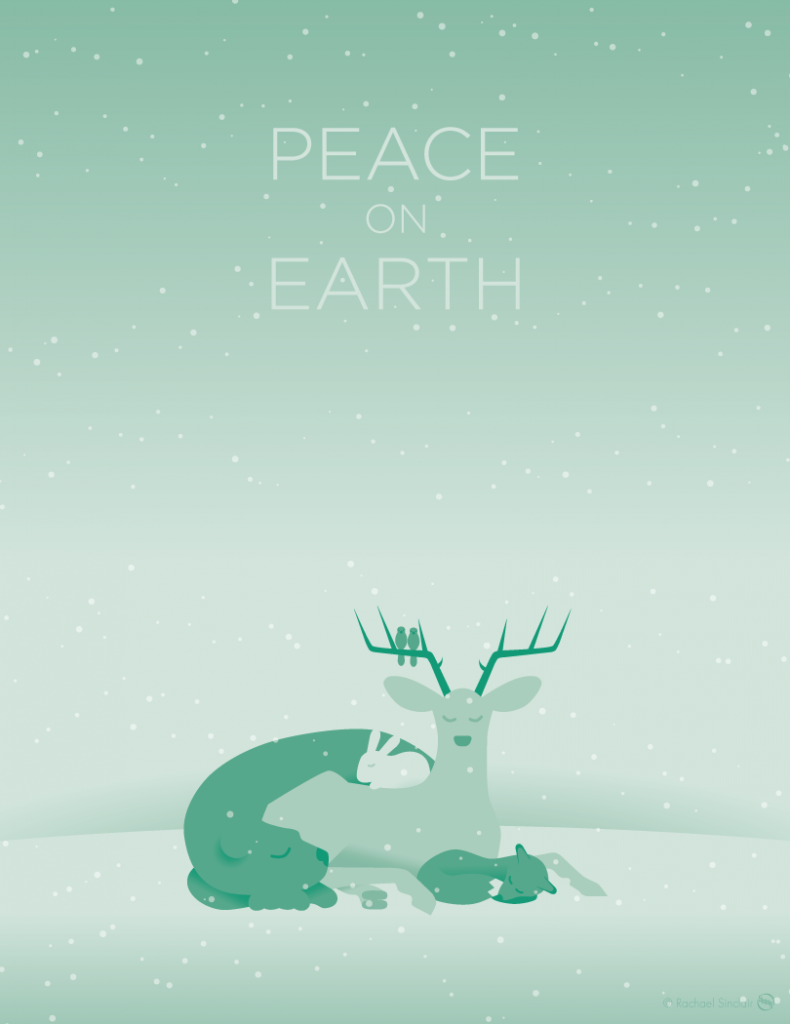
Peace on Earth: Christmas 2012

The holidays should be a time of peace, but often, they are merely a pregnant pause in the hectic and spiteful world. With the hardships in our lives today, it's difficult to be calm and quiet. There are those struggling with loss, pain, and joblessness. There are families and loved ones coping with tragedy and uncertainty. But the Lord has given us His peace and if we can let loose the dams in our hearts, the barriers of prejudice, if only for a moment, we can truly know that peace.

I wish for you a peaceful holiday full of love and kindness. God bless!


A Wish of Peace
original vector illustration
© Rachael Sinclair

Thursday, December 6, 2012

Details Matter: Know Your Subject

'It has long been an axiom of mine that the little things are infinitely the most important.' -Sherlock Holmes, A Case of Identity

Design is an art, true, but design and art are not the same. In art, liberties can be taken, but in design, attention to detail is a must. And it could be said that too much research may never be enough. No matter the size of the client or job, a bit of sleuthing can make the difference between success and failure.

In the late 90's, an ad campaign was launched by Quilted Northern tissue featuring cartoon women quilting. Though the intention was fine, the ladies were 'quilting' using knitting needles. This was a costly mistake, teasing the sensibilities of a large demographic: homemakers and housewives. The campaign was eventually revamped to show quilting instead of knitting, but the lesson wasn't a nice one to learn. This is where research could have saved them a lot of time and embarrassment. Knitting and quilting may both use needles, but that in no way means the two are interchangeable.

Agencies and designers work with a lot of different clients. Though it may be familiar for you to work for a coffee shop if you love coffee and know a lot about it, it may not be a simple when the client deals in something outside your realm of expertise. Don't be afraid to take to the books, so to speak, and learn some things. Start by listening to your client, ask lots of questions. Dig deep and pay attention to the smallest of facts. This will not only make your design better, but can really help establish a trusting relationship.

Next, research every angle. If your client has something to do with music and you aren't a musician, give yourself a lesson in musical theory. Don't go by what you think may be okay, start out with a strong foundation and build your house there. You can have a design that's technically good, but if the base concept isn't sound, that design may end up on the scrap heap. And pay special attention to symbols and what they mean. A symbol or term may have a completely different meaning to one group than it does another.

Designers can be crunched for time more than we'd like, but our clients aren't always of a 'get it to me when you can' mentality themselves. If you've listened to your client, gotten to know them and their business, and done your research, what you deliver will be the cream of the crop. "Measure twice, cut once" as they say also applies to design. When you bring your client something that's thoroughly researched, it's easier to move forward without time-wasting error correction.

Jacks of All Trades, designers are detectives with sketchbooks. Knowing a little something about a lot of subjects isn't only beneficial for a trivia buff or Jeopardy contestant. These days, when information is so readily available, there's no excuse for errors of continuity. Be respectful of your client and good things will happen. And remember, you can't quilt with knitting needles.

Wednesday, December 5, 2012

Kentucky Bourbon Balls

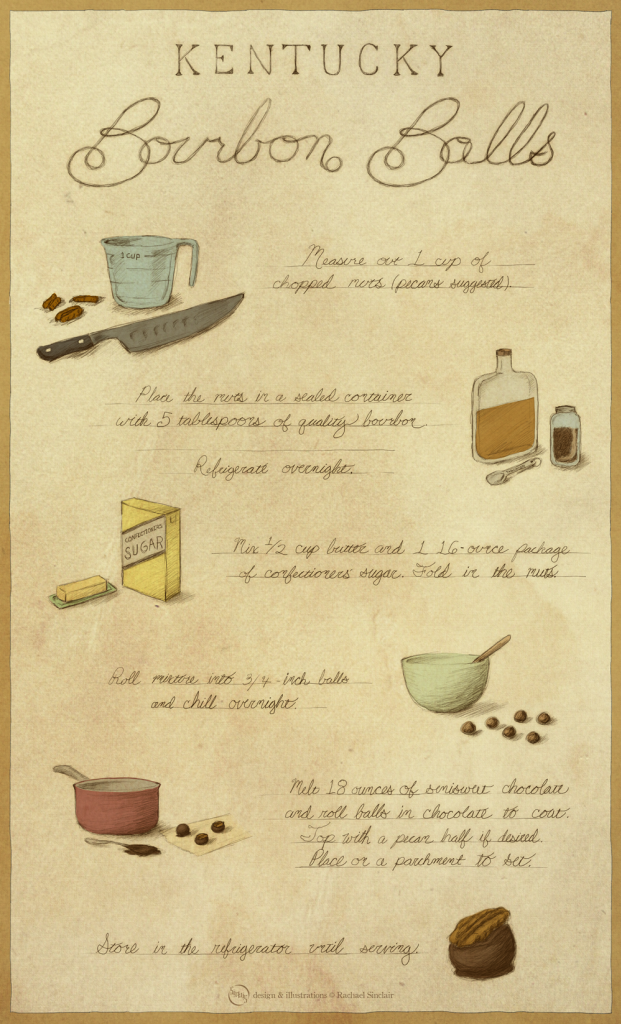
Bourbon is a Kentucky tradition and a source of Bluegrass pride. The bourbon ball candy has been around for generations, a potent truffle of liquor, nuts, and chocolate. These little bits of rich, fun goodness (just one of the many types of recipe featured below) would be great for a holiday gift or to serve at a party. Enjoy your treats responsibly!

Click to embiggen!
Kentucky Bourbon Balls
hand drawn recipe
© Rachael Sinclair

Tuesday, November 13, 2012

Birds of Kentucky: Eastern Wild Turkey

The varied topography of Kentucky is home to a wide range of plants and wildlife. The feathered variety is no exception. I love wild birds; they're fascinating and all so different. They have been a great inspiration to creatives for eons, not just for their form and color, but for their personalities, songs, and symbolism. In these posts (I hope to do a series) I will introduce you to some of Kentucky's native birds with some facts and a special illustration.

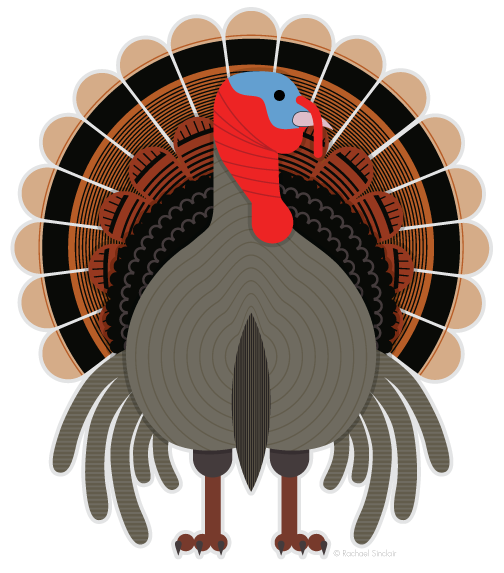
As Thanksgiving approaches, our minds may conjure up the image of Tom Turkey, the jovial nodding character from the Macy's Thanksgiving Day Parade. Kentucky is home to the Eastern subspecies of Wild Turkey (Meleagris gallopavo silvestris), a large, imposing bird. Though most turkeys prepared for the holiday are the domesticated variety, bred from a Mexican turkey subspecies long ago, there's no denying the commanding presence of the wild turkey.


This bird can reach 4 feet tall and males can weigh up to 30 pounds. Their body feathers are warm brownish gray and the males have red and blue featherless skin on their heads. Males also have red waddles at the throat and base of the neck. The tail feathers, a fan of mahogany and cinnamon, are tipped with a chestnut color, thus differentiating them from the other subspecies of wild turkey.

Habitat Diet Nesting Conservation Status
Open Woodland Omnivore Ground Least Concern

In the Bluegrass, wild turkeys can be found in open forests and farmland near wooded areas. They may come out to feed in fields, especially in the late summer and fall after the crops have been harvested. They're a foraging species, feeding on nuts, seeds, berries, insects, and even small reptiles. They make their nests on the ground, in shallow dirt craters protected by forest vegetation. Hens lay an average of 10-14 eggs with the young (called poults) leaving the nest mere days after hatching.

Though some may feel they have a face only a turkey mother could love, wild turkeys are strong, majestic birds in their own right. Native Americans, especially eastern tribes, favored the turkey as a food source, eating not only the meat, but the eggs. The feathers often made their way into ritual dress and equipment. So steeped in tradition was the turkey even in the infancy of the United States, Benjamin Franklin theorized it may be more fit than the Bald Eagle for the national bird. In a letter to his daughter, Franklin called the turkey a "Bird of Courage".

This Thanksgiving, as you gather with your loved ones, pay mind to the turkey. The turkey has been a source of nourishment and conviviality for thousands of years. May the blessing of food, warmth, health, and family be with you this holiday season!

Sources: Cornell Lab of Ornithology and Wikipedia